West China Journal of Stomatology ›› 2026, Vol. 44 ›› Issue (1): 72-81.doi: 10.7518/hxkq.2026.2025440
• Special Review • Previous Articles Next Articles
Sa Yue1,2,3( ), Cai Yingqi1,2, Sun Yitong1,2, Zhao Mingyu1,2, Xia Shici1,2
Received:2025-11-07
Online:2026-02-01
Published:2026-02-02
Contact:
Sa Yue
E-mail:sayue@whu.edu.cn
Supported by:CLC Number:
Sa Yue, Cai Yingqi, Sun Yitong, Zhao Mingyu, Xia Shici. Assistance and breakthrough of digitalization and intelligent digitalization in implant restoration of edentulous jaws[J]. West China Journal of Stomatology, 2026, 44(1): 72-81.
Add to citation manager EndNote|Ris|BibTeX
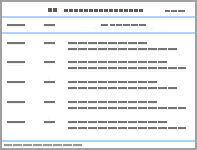
Tab 1
Features of digitalization and intelligent digitalization in implant surgery
| 项目 | 静态种植导板 | 动态导航技术 | 口腔种植机器人 |
|---|---|---|---|
| 核心操作流程 | 获取CBCT及口扫数据后进行手术规划,经CAD/CAM设计制作导板,术中验证导板贴合度,自由手操作下由金属套筒引导钻针路径 | 红外光学系统将CBCT影像与术区配准,实时追踪钻针路径,灵活修改手术方案,自由手进行手术 | 在动态导航的基础上增设机械臂,患者全程需佩戴口外标记物,由机械臂执行手术操作 |
| 术中灵活性 | 低 | 高 | 高 |
| 操作门槛 | 低 | 高 | 高 |
| 整体成本 | 低 | 高 | 高 |
| 患者舒适度 | 低 | 高 | 中 |
| 适用病例 | 骨条件良好的简单病例 | 解剖结构复杂、多植体、无牙颌等复杂病例 | 解剖结构复杂、多植体、无牙颌等复杂病例 |
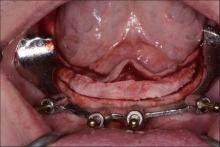
Fig 1
Metal osteotomy guide
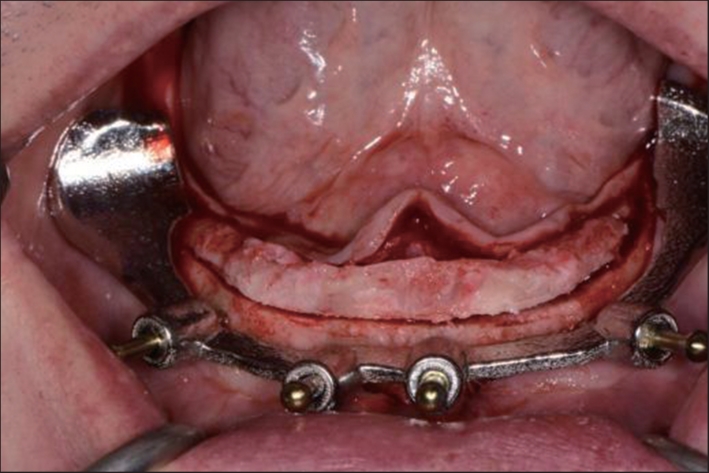
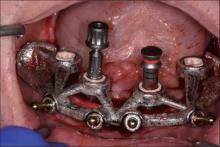
Fig 2
The metal implant surgical guide is positioned in a stacka-ble configuration on top of the metal osteotomy guide
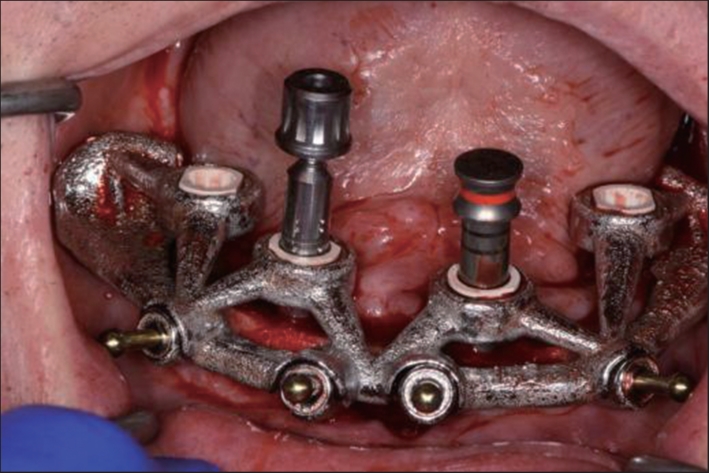
Fig 3
Using the metal surgical guide, the implants are accurately positioned in the predetermined sites
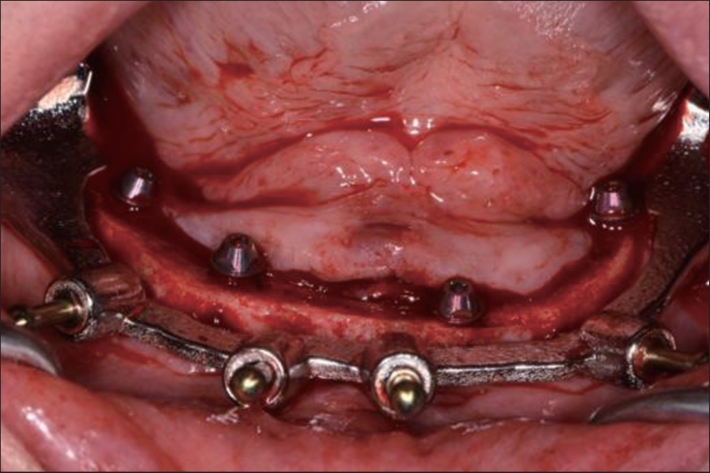
Fig 4
TruAbutment scan bodies are attached to the mandibular implants
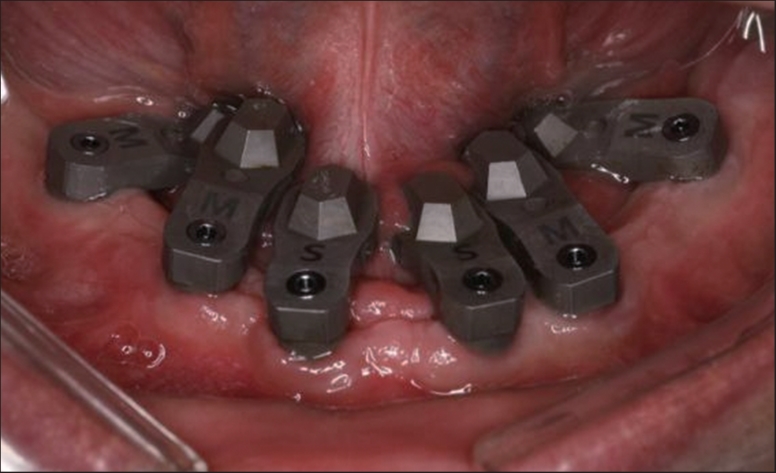
Fig 5
Intraoral scanning data are acquired using a fifth-generation 3Shape intraoral scanner
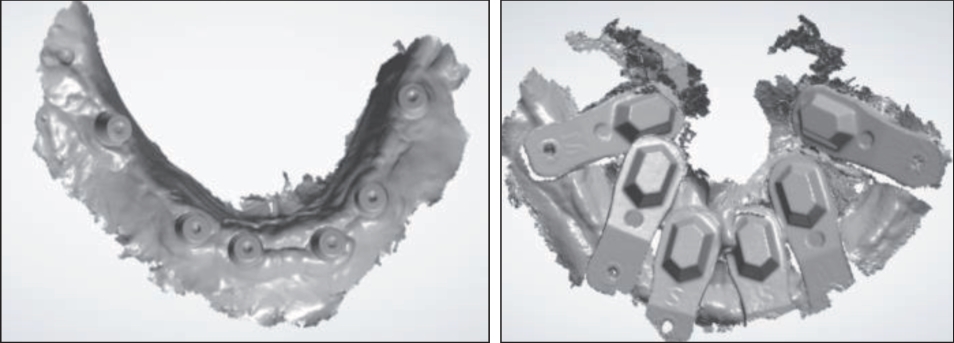
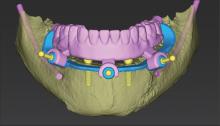
Fig 6
A provisional restoration for immediate loading is preoperatively designed
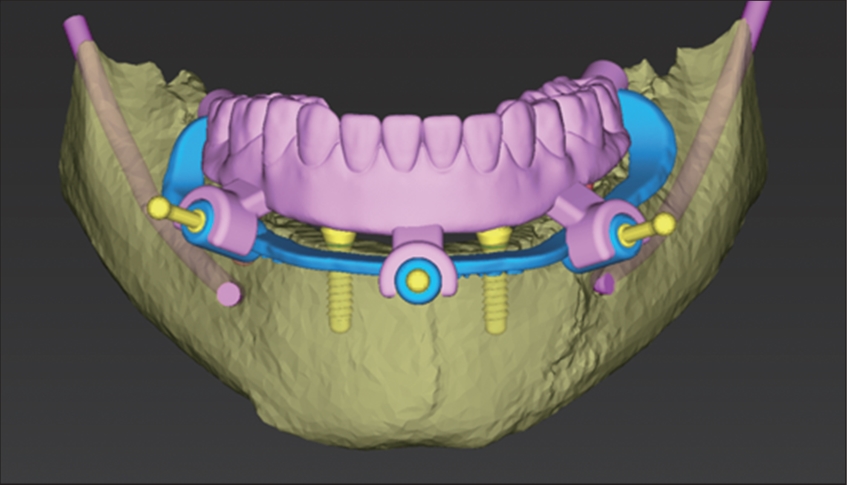
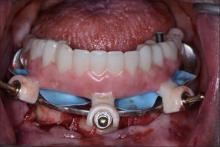
Fig 7
A PMMA provisional restoration is fabricated by CAD/CAM milling and its accurate fit is verified by positioning it on the osteotomy guide
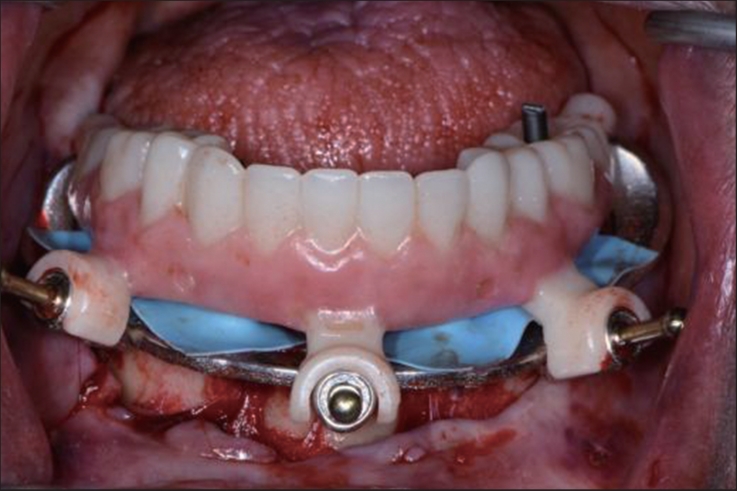
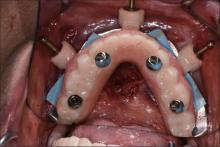
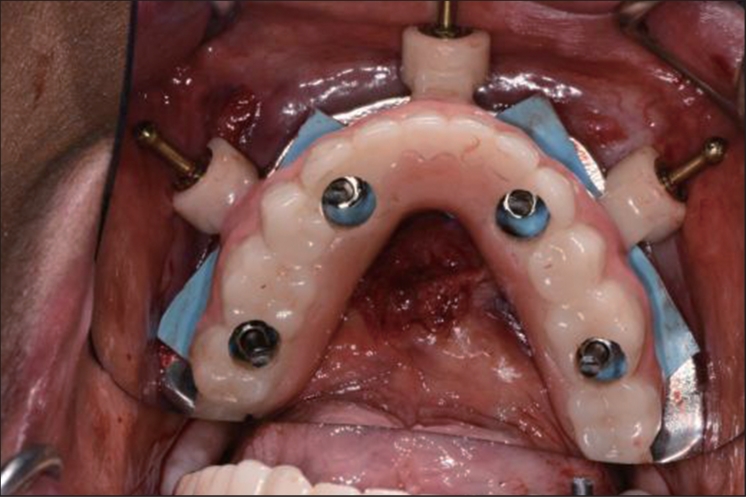
Fig 8
The prefabricated provisional restoration is connected intraorally using a simple ‘pick-up’ procedure, allowing it to function as an immediate loading prosthesis
| [1] | Papaspyridakos P, Chen CJ, Gallucci GO, et al. Accuracy of implant impressions for partially and completely edentulous patients: a systematic review[J]. Int J Oral Maxillofac Implants, 2014, 29(4): 836-845. |
| [2] | Gao YT, Zhao MY, Xia SC, et al. Knowledge structure and research hotspots on digital scanning for implant-supported complete-arch prosthesis: a bibliometric analysis[J]. Heliyon, 2024, 10(17): e36782. |
| [3] | Yuan Y, Liu Q, Yang S, et al. Four-dimensional superimposition techniques to compose dental dynamic virtual patients: a systematic review[J]. J Funct Biomater, 2023, 14(1): 33. |
| [4] | Lepidi L, Kim BC, Giberti L, et al. The 4D virtual patient: a proof of concept in digital dentistry[J]. J Prosthet Dent, 2025, 134(5): 1442-1445. |
| [5] | Wang J, Wu YL, Ma J, et al. A novel technique for implant-supported fixed complete rehabilitation based on a dynamic virtual patient[J]. J Dent, 2023, 137: 104649. |
| [6] | Li JY, Joda T, Revilla-León M, et al. Recommendations for successful virtual patient-assisted esthetic implant rehabilitation: a guide for optimal function and clinical efficiency[J]. J Esthet Restor Dent, 2024, 36(1): 186-196. |
| [7] | Pirc M, Wenk S, Peter D, et al. Four-dimensional (4D) virtual simulation for predicting soft tissue support and vertical dimension of occlusion in full-arch implant the-rapy—A proof of concept[J]. J Dent, 2025, 163: 106142. |
| [8] | Elgarba BM, Fontenele RC, Du XJ, et al. Artificial intelligence versus human intelligence in presurgical implant planning: a preclinical validation[J]. Clin Oral Implant Res, 2025, 36(7): 835-845. |
| [9] | Shalash M, Zohnee A. The application of artificial intelligence in full arch computer assisted implant surgery—A clinical study[J]. Digit Dent J, 2025, 1(1): 100005. |
| [10] | Mangano FG, Yang KR, Lerner H, et al. Artificial intelligence and mixed reality for dental implant planning: a technical note[J]. Clin Implant Dent Rel Res, 2024, 26(5): 942-953. |
| [11] | Zhao WB, Teng WW, Su YC, et al. Accuracy of dental implant surgery with freehand, static computer-aided, dynamic computer-aided, and robotic computer-aided implant systems: an in vitro study[J]. J Prosthet Dent, 2025, 134(6): 2416-2423. |
| [12] | Tuce RA, Neagu M, Pupazan V, et al. The 3D printing and evaluation of surgical guides with an incorporated irrigation channel for dental implant placement[J]. Bioengineering, 2023, 10(10): 1168. |
| [13] | Lan R, Marteau C, Mense C, et al. Current knowledge about stackable guides: a scoping review[J]. Int J Implant Dent, 2024, 10(1): 28. |
| [14] | Bai XY, Wu T, Zhu YX, et al. Cone-wedge anchored surgical templates for stackable metal guide: a novel technique[J]. Int J Implant Dent, 2024, 10: 27. |
| [15] | Alhazmi AA, Alharbi MT, Lahiq A, et al. Application of metallic guides and reverse scanning for full-mouth rehabilitation using implant-supported prostheses: a case report[J]. J Prosthodont, 2025, 34(8): 777-783. |
| [16] | di Giacomo GP, Cury PR, da Silva AM, et al. Surgical guides for flapless dental implant placement and immediate definitive prosthesis installation by using selective Laser melting and sintering for 3D metal and polymer printing: a clinical report[J]. J Prosthet Dent, 2024, 131(2): 177-179. |
| [17] | Yao YF, Yang RL, Lam W, et al. A modified workflow for dynamic navigation implant surgery in fully edentulous patients utilizing a customized patient tracking mo-dule[J]. J Stomatol Oral Maxillofac Surg, 2025, 126(4): 102292. |
| [18] | Wang NR. Comparison of dynamic navigation and static navigation systems in implant surgery: accuracy and application analysis[J]. BIO Web Conf, 2025, 174: 03006. |
| [19] | Pozzi A, Carosi P, Laureti A, et al. Accuracy of navigation guided implant surgery for immediate loading complete arch restorations: prospective clinical trial[J]. Clin Implant Dent Rel Res, 2024, 26(5): 954-971. |
| [20] | Liu C, Liu YC, Xie R, et al. The evolution of robotics: research and application progress of dental implant robotic systems[J]. Int J Oral Sci, 2024, 16: 28. |
| [21] | Bahrami R, Pourhajibagher M, Nikparto N, et al. Robot-assisted dental implant surgery procedure: a literature review[J]. J Dent Sci, 2024, 19(3): 1359-1368. |
| [22] | Wang WX, Xu H, Mei DM, et al. Accuracy of the Ya-kebot dental implant robotic system versus fully guided static computer-assisted implant surgery template in edentulous jaw implantation: a preliminary clinical stu-dy[J]. Clin Implant Dent Rel Res, 2024, 26(2): 309-316. |
| [23] | Shu QY, Chen DP, Wang X, et al. Accuracy of flapless surgery using an autonomous robotic system in full-arch immediate implant restoration: a case series[J]. J Dent, 2024, 145: 105017. |
| [24] | Xie R, Liu YC, Wei HB, et al. Clinical evaluation of autonomous robotic-assisted full-arch implant surgery: a 1-year prospective clinical study[J]. Clin Oral Implant Res, 2024, 35(4): 443-453. |
| [25] | Rong R, Lin TY, Sa Y. Using an existing digital surgical guide and used burs as aids for a complete-arch implant impression[J]. J Prosthet Dent, 2022, 127(4): 664-666. |
| [26] | Gómez-Polo M, Cimolai A, Ortega R, et al. Accuracy, scanning time, and number of photograms of various scanning patterns for the extraoral digitalization of complete dentures by using an intraoral scanner[J]. J Prosthet Dent, 2024, 131(3): 521-528. |
| [27] | Revilla-León M, Gómez-Polo M, Drone M, et al. Accuracy of complete arch implant scans recorded by using intraoral and extraoral photogrammetry systems[J]. J Prosthet Dent, 2025, 134(6): 2508-2514. |
| [28] | Revilla-León M, Cascos R, Barmak AB, et al. Clinical accuracy of complete arch implant scans recorded by using a noncalibrated splinting technique, intraoral photogrammetry, and extraoral photogrammetry with snap-on markers[J]. J Prosthet Dent, 2025. DOI:10.1016/j.prosdent.2025.09.012 . |
| [29] | Srivastava G, Padhiary SK, Mohanty N, et al. Accuracy of intraoral scanner for recording completely edentulous Arches: a systematic review[J]. Dent J, 2023, 11(10): 241. |
| [30] | Sampaio-Fernandes MA, Pinto R, Almeida PR, et al. Accuracy of extraoral digital impressions with multi-unit implants[J]. Appl Sci, 2023, 13(15): 8769. |
| [31] | Abuduwaili K, Huang RX, Song JY, et al. Comparison of photogrammetric imaging, intraoral scanning and conventional impression accuracy of full-arch dental implant rehabilitation: an in vitro study[J]. BMC Oral Heal, 2025, 25: 753. |
| [32] | Anitua E, Lazcano A, Anitua B, et al. Influence of scan body geometry on the trueness of intraoral scanning[J]. BDJ Open, 2025, 11: 83. |
| [33] | Zhang TT, Yang B, Ge RH, et al. Effect of a novel ‘scan body’ on the in vitro scanning accuracy of full-arch implant impressions[J]. Int Dent J, 2024, 74(4): 847-854. |
| [34] | Wu HK, Wang J, Chen GH, et al. Effect of novel prefabricated auxiliary devices attaching to scan bodies on the accuracy of intraoral scanning of complete-arch with multiple implants: an in-vitro study[J]. J Dent, 2023, 138: 104702. |
| [35] | Ma HY, Cao J, Tang ZH, et al. Case report: accuracy analysis of a new scanning body for intraoral digital impressions in full-arch edentulous patients[J]. Front Oral Health, 2025, 6: 1528943. |
| [36] | Li YX, Fang H, Yan YW, et al. Accuracy of intraoral scanning using modified scan bodies for complete arch implant-supported fixed prostheses[J]. J Prosthet Dent, 2024, 132(5): 994.e1-994.e8. |
| [37] | Gianfreda F, Raffone C, Martelli M, et al. Conventional scan body vs. scan bodies with auxiliary geometric devices: an in vitro study for edentulous full-arch implant impressions[J]. Front Oral Heal, 2025, 6: 1574149. |
| [38] | Eldabe AK, Adel-Khattab D, Botros KH. Trueness of tooth modified scan bodies as a novel technique for edentulous full arch implant supported dental prosthesis: an in vivo prospective comparative study[J]. BMC Oral Heal, 2025, 25: 29. |
| [39] | Revilla-León M, Cascos R, Barmak AB, et al. Influence of an artificial intelligence-based application on the accuracy of complete arch implant scans recorded by using an intraoral scanner[J]. J Prosthet Dent, 2025, 134(6): 2471-2481. |
| Feng X, Liu M, Song WE, et al. Efficacy of digital templates in edentulous implant placement: a retrospective study[J]. BMC Oral Heal, 2024, 24: 1503. | |
| [40] | Martins J, Rangel J, de Araújo Nobre M, et al. A new full digital workflow for fixed prosthetic rehabilitation of full-arch edentulism using the all-on-4 concept[J]. Medicina, 2024, 60(5): 720. |
| [41] | Rustichini F, Romolini R, Salmi MC, et al. Implant-supported full-arch fixed dental prostheses manufactured through a direct digital workflow using a calibrated splinting framework: a retrospective clinical study[J]. J Dent, 2025, 154: 105605. |
| [42] | Auduc C, Douillard T, Nicolas E, et al. Fully digital workflow in full-arch implant rehabilitation: a descriptive methodological review[J]. Prosthesis, 2025, 7(4): 85. |
| [43] | Fu Y, Yin CL, Li SQ, et al. A full digital workflow to prefabricate an implant-supported interim restoration: case report and a novel technique[J]. Int J Implant Dent, 2022, 8: 55. |
| [44] | Lyu TL, Wu Z, Ma GG, et al. PDS-MAR: a fine-grained projection-domain segmentation-based metal artifact reduction method for intraoperative CBCT images with guidewires[J]. Phys Med Biol, 2023, 68(21): 215007. |
| [45] | Jiang C, Lyu TL, Ma GG, et al. CBCT projection domain metal segmentation for metal artifact reduction using hessian-inspired dual-encoding network with guidance from segment anything model[J]. Med Phys, 2025, 52(6): 3900-3913. |
| [46] | Rong R, Lv H, Sa Y. Single scanning of CBCT and in-traoral scanning for guided implantation in terminal dentitions with multi-unit metal restorations: technical note[J]. J Stomatol Oral Maxillofac Surg, 2024, 125(6): 101784. |
| [47] | Lv H, Wu H, Hu L, et al. Pterygoid implant-based maxillary full-arch rehabilitation using an autonomous robot system: a case report[J]. J Prosthodont, 2025, 34(3): 232-239. |
| [1] | Wu Hao, Cao Ning, Cao Liangwei, Yu Fei, Zhang Xu, Wei Shibo, Wei Hongwu, Guo Shuigen. Clinical efficacy of simple taper-retained external connection narrow-diameter implants applied in the narrow alveolar ridge of the premolar region: a 5-8-year follow-up study [J]. West China Journal of Stomatology, 2026, 44(1): 120-128. |
| [2] | Lai Wenli. Discussion on the application of clear aligner treatment in multidisciplinary complex cases [J]. West China Journal of Stomatology, 2026, 44(1): 9-16. |
| [3] | Chen Jiang, Wu Ling. Initial exploration of the relationship between homeostatic occlusion and long-term dental implant stability [J]. West China Journal of Stomatology, 2025, 43(6): 749-754. |
| [4] | Wang Jing, Man Yi. Interpretation of the group standard: Clinical Protocol for Bone Harvesting and Grafting under Digital Guidance in Oral Implantology [J]. West China Journal of Stomatology, 2025, 43(6): 755-762. |
| [5] | Gu Yiping, Yang Shengtao, Yuan Quan. Clinical decision-making for immediate restoration of terminal dentition: determination and transfer of jaw relations [J]. West China Journal of Stomatology, 2025, 43(6): 763-770. |
| [6] | Yang Yongtao, Li Xin, Shang Xiangyi, Shan Shenyao, Li Wenbo, Qin Qingzhao, Wang Yong, Zhao Yijiao. Comparative study on the accuracy of extraoral scanning versus intraoral scanning in digital impressions for implant restoration in edentulous jaws [J]. West China Journal of Stomatology, 2025, 43(6): 771-779. |
| [7] | Zhang Xu, Wan Zengxuan, Wei Shibo, Yu Fei, Cao Ning, Cao Liangwei, Wu Hao, Guo Shuigen, Wei Hongwu. Analysis of risk factors for early failure of simple taper retentive implants [J]. West China Journal of Stomatology, 2025, 43(6): 780-788. |
| [8] | Wei Xueqin, Zhang Shengzhi, Ba Kai. Evaluation of the clinical effect of concentrated growth factor combined with sticky bone in maxillary anterior alveolar ridge preservation [J]. West China Journal of Stomatology, 2025, 43(5): 671-678. |
| [9] | Chen Shuangzhen, Zhang Xianyue, Jia Xiaofeng, Xia Rong, Jiang Fan. Effect of trapezoidal and modified triangular flaps on mucosal blood supply and osteogenesis after guided bone regeneration [J]. West China Journal of Stomatology, 2025, 43(5): 679-688. |
| [10] | Li Xin, Lu Yuzong, Yang Yongtao, Wen Aonan, Wang Yong, Zhao Yijiao. Preliminary study on the influence of the dimensional stability of 3D printed resin master model on the replication accuracy of implant replicas [J]. West China Journal of Stomatology, 2025, 43(5): 689-695. |
| [11] | Yang Zizhen, Li Qiang, Pang Yunqing. Heterotopic replantation and delayed implant restoration following complete avulsion of maxillary central incisors: a case report [J]. West China Journal of Stomatology, 2025, 43(4): 534-540. |
| [12] | Cui Xinxin, Pang Xiao, Liu Chang, Pan Jian, Wang Liao, Liu Jiyuan. Chinese introduction to Preferred Reporting Items for Animal Studies in Endodontology 2021 checklist [J]. West China Journal of Stomatology, 2025, 43(4): 541-546. |
| [13] | Wu Hao, Cao Ning, Cao Liangwei, Yu Fei, Zhang Xu, Wei Shibo, Wei Hongwu, Guo Shuigen. Clinical efficacy of demineralized dentin matrix particles in immediate implantation for bone defects in posterior region: a 1 to 5-year follow-up study [J]. West China Journal of Stomatology, 2025, 43(4): 570-583. |
| [14] | Zhao Pengyu, Chen Gang, Cheng Yi, Wang Chao, Chen Dan, Huang Haitao. Clinical and histological evaluation of three-dimensional printing individualized titanium mesh for alveolar bone defect repair [J]. West China Journal of Stomatology, 2025, 43(4): 592-602. |
| [15] | Du Xin, Wen Aonan, Gao Zixiang, Li Zhihua, Zhang Sheng, Wang Yong, Zhao Yijiao. Digital design and manufacturing method of double constrained split guide for orthodontic miniscrew implantation [J]. West China Journal of Stomatology, 2025, 43(4): 603-612. |
| Viewed | ||||||
|
Full text |
|
|||||
|
Abstract |
|
|||||
 This work is licensed under a Creative Commons Attribution 3.0 License.